

When Plants Talk: Decoding Nature’s Secret System for Growth and Defence
How new discoveries about plant cell-wall communication could redefine crop resilience, biological control, and sustainable farming.

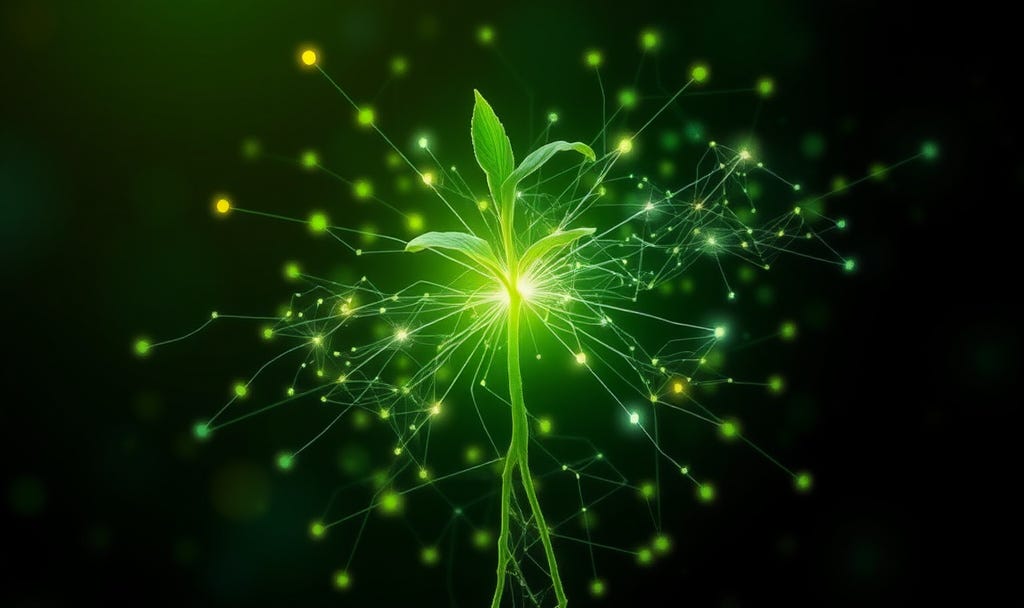
For centuries, plants were seen as silent — rooted organisms that endured the world rather than responded to it. But science keeps rewriting that story. Recent research now reveals that plants possess a complex language of their own, whispered not through words but through their cell walls. Far from being rigid barriers, these walls are active communication centers — sending, receiving, and translating signals that shape how plants grow, heal, and defend themselves.
A feature published in Nature (Amber Dance, 2025) captures this revolution in plant biology: scientists are only beginning to decipher how cell walls talk. The discovery is not just elegant science. It may transform how we grow food, manage pests, and build resilient agriculture for the future.
The Cell Wall: From Barrier to Brain
For decades, the plant cell wall was treated like scaffolding — a structure that gives shape but little else. Now it’s turning out to be more like a sensor-laden membrane, constantly alert to changes in its surroundings.
When a plant’s wall is stressed — by drought, attack, or even normal growth — molecules within it break or shift. These subtle changes send biochemical messages to the cell interior, triggering adjustments in metabolism, growth, or immunity. Researchers call this the cell wall integrity (CWI) sensing pathway, and it is now viewed as one of the key signal networks coordinating life in plants.
In short, plants don’t just react to stress — they perceive it, through touch, tension, and chemical cues in their own walls.
Pectins: The Soft Spokespersons of the Wall
Among the many molecules composing the wall, pectins are emerging as eloquent communicators. These complex polysaccharides give fruits their familiar jelly-like feel, but in plants, they serve as dynamic messengers.
When pathogens attempt to invade, enzymes known as pectinases cleave these molecules. The resulting fragments — oligogalacturonides — act like distress calls, activating immune genes and reinforcing nearby cells. This biochemical alarm primes the plant’s defences long before visible symptoms appear.
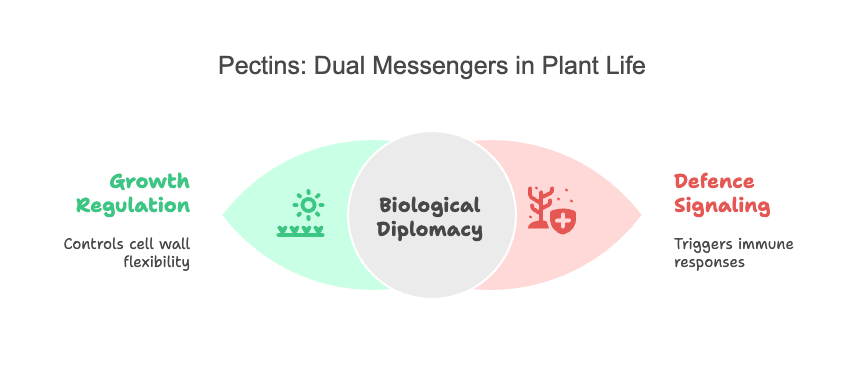
But pectins also mediate growth. Their degree of methylation, adjusted by enzymes called pectin methylesterases, determines how soft or rigid a wall becomes — guiding cell elongation, root formation, and even fruit ripening.
Thus, pectins form the dual language of growth and defence — a kind of biological diplomacy where the same molecules can either open pathways for expansion or trigger emergency fortification.
Decoding the Secret Signals
Scientists are now mapping this hidden vocabulary of wall-derived messages. Each chemical modification — a cut, a twist, a binding — can activate specific cascades involving hormones such as jasmonates, auxins, and ethylene. Together, these pathways balance survival and growth, helping plants decide when to grow taller or tougher.
The possibilities are enormous. If we learn to interpret or amplify these natural signals, we could engineer plants that recognise and resist pathogens faster, or adapt better to drought and soil stress without external chemicals. It is, in essence, an invitation to build crop resilience from within the plant itself.
Implications for Crop Growth and Productivity
For farmers and researchers, this discovery could mark a turning point. Imagine crops that sense stress early and adjust growth before damage sets in. Instead of relying entirely on pesticides or fertilisers, plants could harness their own built-in signalling systems to manage threats and optimise growth.
In spice crops such as black pepper, where fungal and nematode infestations often strike roots unseen, cell-wall signalling could be a silent ally. Microbial partners like Pochonia chlamydosporia — already known for their endophytic behaviour — might interact directly with these wall pathways, priming the plant’s immune network even before pathogens arrive.
Such insights could eventually reshape biological control: from applying living agents externally to nurturing internal plant–microbe dialogues that reinforce resilience naturally.
A New Frontier in Pest and Disease Resistance
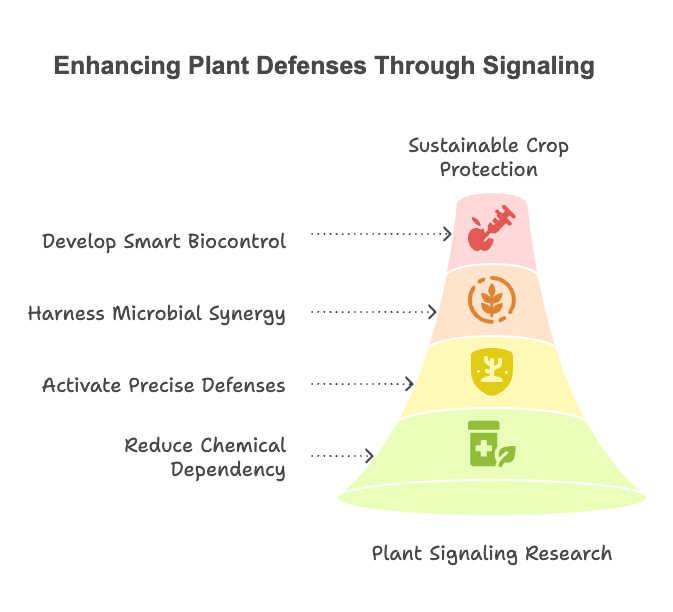
One of the most exciting outcomes of this research is its potential to reduce chemical dependency. By tuning wall-mediated signalling, crops could respond more precisely to attacks, activating defences only when needed. This would cut unnecessary energy expenditure and lessen ecological impact.
There’s growing evidence that beneficial microbes can “whisper” to plants through these same channels. When endophytes colonise roots or stems, they subtly modify wall chemistry — sometimes mimicking the signals of mild stress, which primes the plant’s defences without harming it. Harnessing this synergy could yield a new generation of smart biocontrol strategies, grounded not in external inputs but in the plant’s own communicative intelligence.
Still, the leap from lab discovery to field transformation requires patience. As another Nature commentary (Khaipho-Burch et al., 2023) cautioned about genetic modification, not every laboratory triumph translates to farm success. Yield and resilience depend on complex interactions among genes, soil, microbes, and climate.
The same humility applies here. Most wall-signalling research comes from model plants such as Arabidopsis. Translating those findings to spices, rice, or pulses means testing across diverse soils, climates, and management systems. Single molecular tweaks rarely deliver magic; systems integration does.
To truly harness this knowledge, research institutes and agricultural universities must converge, combining molecular biology, soil science, and farmer practice. Only then can cell-wall insights grow from petri dishes into policies and products that matter.
From Molecular Signals to Regenerative Systems
Interestingly, these new discoveries echo the broader movement in global farming toward regenerative agriculture, another trend highlighted in Nature (April Reese, 2025). Regenerative systems rebuild soil health, encourage biodiversity, and minimise chemical reliance — exactly the conditions that enhance a plant’s natural communication networks.
Healthy soils, teeming with microbial diversity, can amplify cell-wall integrity pathways, improve stress tolerance, and even influence how plants allocate resources between growth and defence. In that sense, regenerative practices act as amplifiers of plant intelligence. They don’t just grow crops; they grow communication.
In our agricultural fields, integrating these approaches — microbial soil management, minimal tillage, and multi-strata cropping — could strengthen the very systems that modern research is now decoding at the molecular level.
Future Directions – Listening to the Plant’s Voice
What happens when we stop forcing plants to fit our systems and start tuning in to theirs? The future of agriculture may depend on how well we learn to listen — not just to market signals but to molecular ones.
Advances in AI-assisted transcriptomics and metabolomics are helping scientists map plant communication in unprecedented detail. Soon, we may visualise how stress ripples through the wall network in real time, or how beneficial fungi “speak” to roots through pectin fragments.
These tools, combined with regenerative principles and realistic field trials, could pave the way for a new era of intelligent agriculture — one where crops grow resiliently by design, guided by the language evolution already taught them.
Take-Home Message
Plants are not silent. Their walls vibrate with chemical whispers of defence, cooperation, and adaptation. By decoding this hidden communication system, science offers a path toward crops that protect themselves, thrive in stress, and harmonise with their microbial allies.
Yet, as with all promising discoveries, balance is key. True progress will come not from overhyping molecular magic, but from connecting lab insights to the living complexity of soils, microbes, and farmers’ fields.
Listening to plants may well be the most transformative act modern agriculture can undertake — and perhaps the quietest revolution of all.
Additional Reading
Amber Dance 2025. Plants have a secret language that scientists are only now starting to decipher. https://doi.org/10.1038/d41586-025-03473-y
April Reese, 2025. A revolution is sweeping Europe’s farms: can it save agriculture? https://doi.org/10.1038/d41586-025-02812-3
Khaipho-Burch et al., 2023. Genetic modification can improve crop yields — but stop overselling it. https://doi.org/10.1038/d41586-023-02895-w
I read the Nature article before reading yours, but your article helps me to put that article in a larger perspective. I am personal interest lies in the intersection of (a) epistemology of academic knowledge (b) higher education, and (c) academic communication. And I have been asking what we can learn from plants such that we can improve the quality of higher education, which, as it currently exists, is not only of very little value, but is even harmful. As we say, we should listen to plants to go beyond NeoDarwinism and the (academic) culture that it spreads in human society.