

Seven Beans, Two Centuries, One Narrow Gene Pool
Our arabica is quietly retreating and our shade is thinning. The rescue has been hiding in our own breeding history, and in forests we are still cutting down.

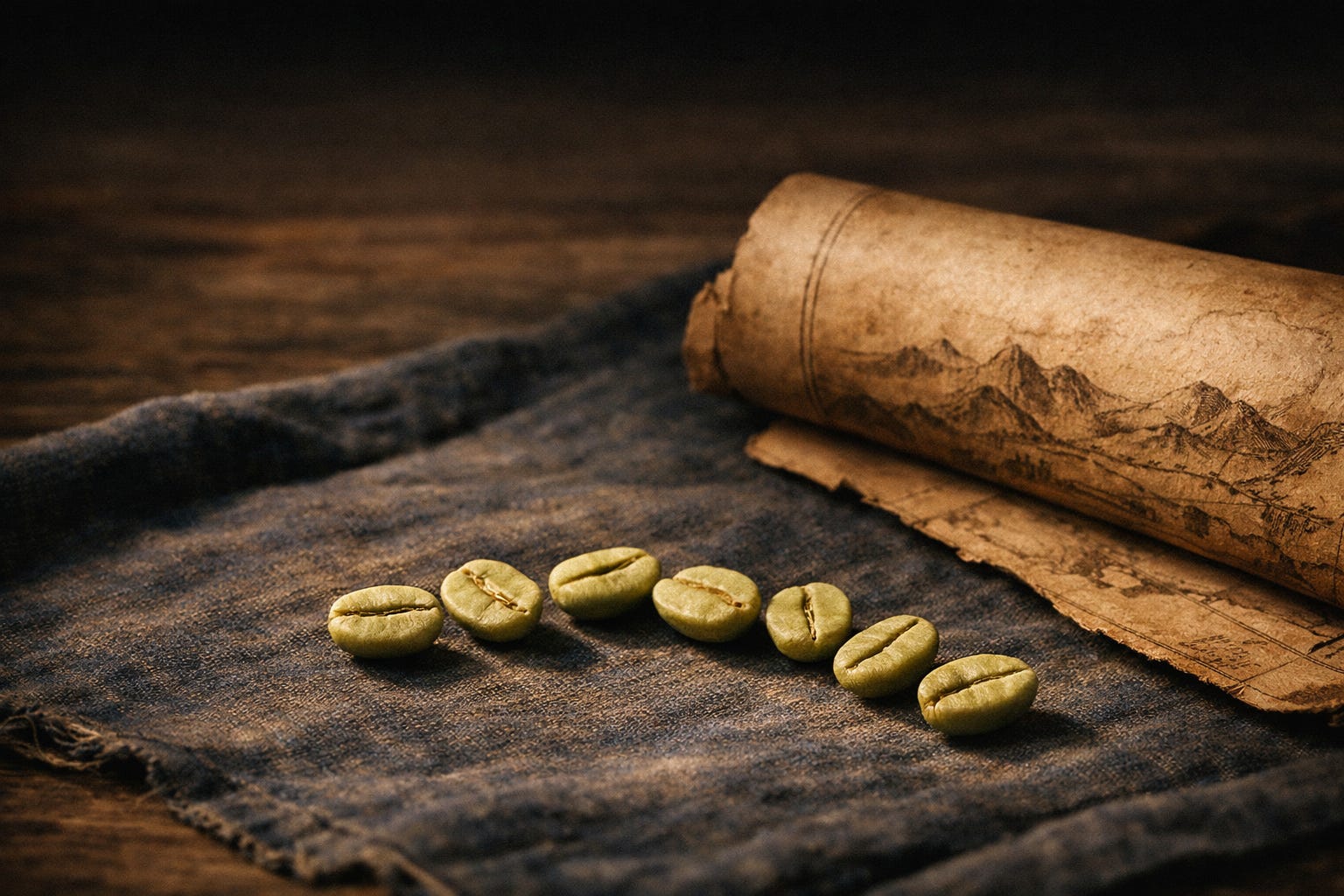
Every Indian coffee story begins with the same legend. The Sufi saint Baba Budan, returning from Mecca in the seventeenth century, carried seven coffee seeds strapped to his body and planted them in the hills of Chandragiri, in what is now Chikkamagaluru. From those seeds, the story goes, grew an industry that today employs around two million people and earns the country a record 1.8 billion dollars a year in exports.
It is a good legend. It is also, unintentionally, a precise description of a genetic problem.
Seven seeds is a founder population. A founder population is a bottleneck. And Coffea arabica was already bottlenecked before Baba Budan touched it, having arisen from a chance cross between C. canephora and C. eugenioides in a small corner of Ethiopia and Yemen, then propagating largely by self-pollination. India inherited a narrow crop and narrowed it further.
We have spent four centuries building a globally admired coffee sector on that inheritance. Climate change is now asking what else the inheritance contains. The honest answer is that we do not have much genetic room left, and the reserves that could give us more are sitting in a research collection in Karnataka and in forests we are steadily clearing.
Research Rundown reads global science through an Indian researcher's lens, one story a week. No noise, no filler. If that is your kind of reading, come aboard.
What India actually grows, and what it has quietly stopped growing
Look past the legend to the ledger. India is the world’s seventh-largest coffee producer. Karnataka accounts for roughly 70 percent of output, Kerala about 20 percent, and Tamil Nadu around 5 percent. Some 250,000 growers work this crop, and 98 percent of them are smallholders.
Now look at the composition of that output, because this is where the story hides. Robusta makes up close to three-quarters of Indian production. Arabica, the species with the higher market value and the finer cup, has been in a long, quiet retreat. The Coffee Board’s post-blossom estimate for 2025 to 2026 put arabica at 118,125 tonnes against robusta’s 284,875 tonnes. Yields tell the same story more brutally. Arabica returns roughly 384 kilograms per hectare against robusta’s 1,276.
Growers are not abandoning arabica out of fashion. They are abandoning it because it keeps losing. It loses to white stem borer. It loses to leaf rust. It loses to a monsoon that arrives when it should not and vanishes when it should not. Robusta is the rational choice, and every hectare that shifts is a hectare of genetic and ecological simplification.
That shift is not a Karnataka curiosity. It is the same shift happening across tropical Asia, and it is what a crop looks like when it runs out of adaptive options.
The pests that drew the map
India’s coffee geography was drawn by two organisms, and neither has gone away.
White stem borer, Xylotrechus quadripes, began devastating plantations in the 1860s. Coffee leaf rust, Hemileia vastatrix, arrived from Sri Lanka in 1869 and rewrote the industry across South Asia. Indian planters responded with an agronomic answer that has since become the sector’s signature: they grew coffee under dense, diverse native shade. Indian coffee is shade-grown not primarily as a marketing story but as a survival strategy.
That strategy has held for a century and is now under pressure from two directions at once. Kodagu, the single largest coffee-growing district, lost about 77,000 hectares of natural forest, roughly 30 percent, between 1977 and 1997, even as coffee area doubled. Growers under financial stress increasingly replace native shade with exotic timber species, and research from the Western Ghats shows the substitution has real costs: multi-species native canopies buffer the effects of extreme rainfall better than monospecific Grevillea stands, and shade-tree diversity itself lifts both coffee yield and quality.
Meanwhile the climate has stopped cooperating. Analysis reported in early 2026 found that climate change has added roughly 30 extra extreme-heat days a year to India’s coffee farms. Scenario modelling for the cardamom and coffee hotspots of the Western Ghats projects temperature increases spanning 0.5 to 8.5 degrees Celsius and enormous swings in precipitation under RCP 4.5 and 8.5. The 2025 monsoon delivered the consequence directly: excessive rain through berry formation triggered black rot in arabica and fruit rot in robusta, which is why planter associations in Karnataka and Kerala publicly doubted the Coffee Board’s optimistic 403,000-tonne forecast.
A crop with thin genetics, a thinning canopy, and a destabilising monsoon is a crop with very little margin.
What Kodagu taught me
I did not come to this subject from the literature. I came to it from the field.
The early part of my career (1987-93) was spent in Cardamom Research Centre, Appangala, Kodagu, in the coffee tracts of Coorg, and those years shaped how I read every plantation-crop crisis since. Today it is a Regional Station of ICAR-Indian Institute of Spices Research, Kozhikode. What I remember is not the statistics. It is the sound of a planter tapping an arabica stem and knowing, from the hollowness, that the white stem borer had already won. It is the ridge lines where the old native shade still stood, and the neighbouring blocks where it did not, and how differently the two behaved in a bad year.
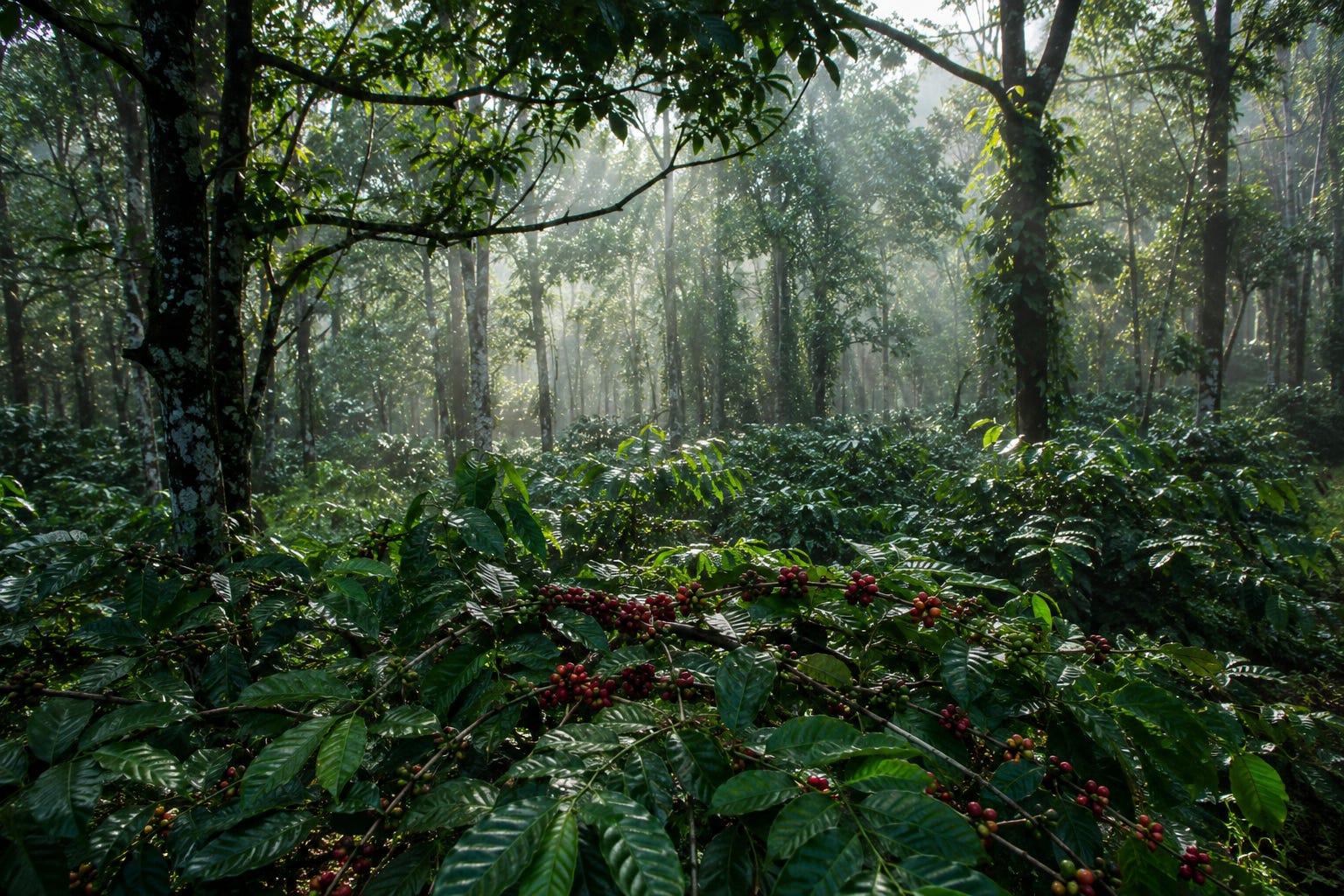
Kodagu is not an abstraction to me. It is the district that grows a third of India’s coffee, and it is where I learned that a pest problem is never only a pest problem. Stem borer pressure tracked the canopy. Rust tracked the variety. The estates that had kept their diversity, in trees and in planting material, absorbed shocks that flattened the estates that had not.
Those lessons were unfashionable then. Yields were rising, replanting with a narrow set of high-performing selections looked like progress, and the argument for keeping messy genetic and ecological variety around sounded like sentimentality. It was not sentimentality. It was insurance, and the premiums were being quietly cancelled.
Four decades later I am watching the same argument play out with better data and less time.
We have done this before, and we have forgotten
Here is the part of the story Indian researchers should be telling louder.
India has already been rescued once by genes from outside cultivated arabica. The most widely planted arabica selections in the country today, Chandragiri (Sln.13) and Selection 9, are Sarchimor and related types. Their rust resistance traces back to Hybrido de Timor, a spontaneous hybrid between C. arabica and C. canephora. Cauvery, Sln.12, comes from the same lineage. Our commercial robusta hybrid CxR is itself an interspecific cross.
Read that again. The varieties holding up Indian arabica cultivation right now carry introgressed genes from another species. Interspecific germplasm is not an exotic future proposal for Indian coffee. It is the load-bearing wall of the present crop, installed decades ago by breeders who understood exactly what they were doing.
So when the international literature urges breeders to look at wild Coffea relatives such as the heat-tolerant C. stenophylla, rediscovered in West Africa after being written off, or the drought-adapted Madagascan species, Indian scientists should not hear a novel idea. They should hear a familiar one, arriving late, with higher stakes.
The collection we are sitting on
India is better positioned than the pessimism suggests, and worse positioned than the complacency admits.
The Central Coffee Research Institute at Balehonnur, which marked its centenary in 2025, maintains a germplasm collection of about 300 arabica accessions, 73 robusta, and 17 other Coffea species. Over its history CCRI has released 13 arabica and 3 robusta varieties, and a white stem borer tolerant arabica is now in multi-location trials.
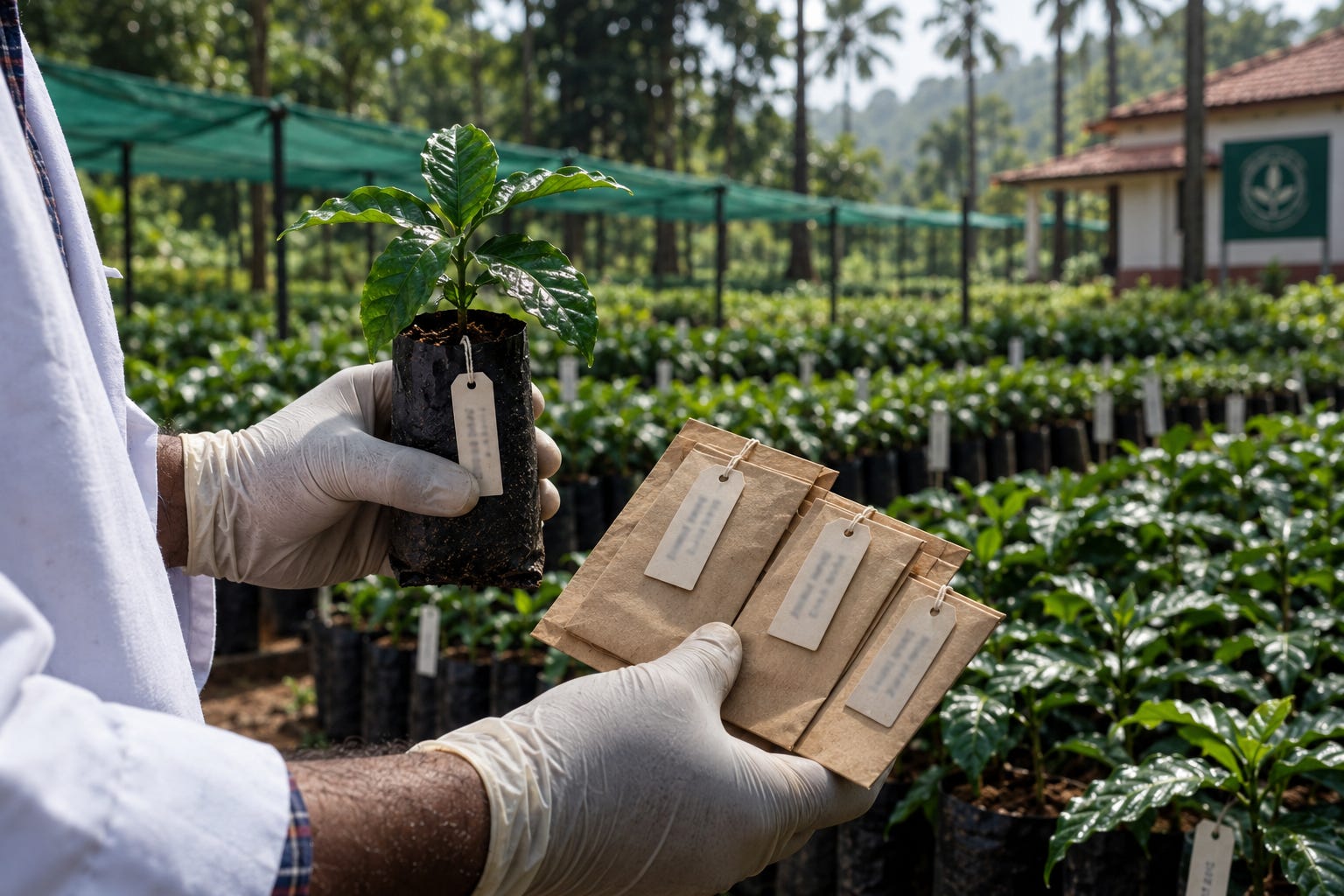
That is a serious national asset, built patiently over a century by people who will never be famous for it. It is also modest against the scale of the problem. Seventeen non-cultivated species is a start, not a strategy, when a global assessment led by Kew concluded that around 60 percent of wild Coffea species face extinction. The insurance policy for the world’s coffee is burning while we are still deciding whether to read it.
And breeding a perennial is punishingly slow. A new coffee variety takes years for the plant to mature and many generations of backcrossing to stabilise. Marker-assisted selection, now genuinely feasible since the arabica genome was resolved in detail, can compress that timeline. It cannot compress it into a monsoon cycle. Every year we delay pre-breeding is a year subtracted from a response we will need in the 2040s.
The smallholder is the whole game
None of this reaches a farm by itself.
Ninety-eight percent of India’s coffee growers are smallholders. A climate-resilient variety that exists only in a trial plot at Balehonnur protects nobody in Wayanad. The bottleneck between a released variety and a planted one is nursery capacity, clean planting material, extension reach, and the simple economics of a grower who cannot afford a failed replanting.
This is where India’s coffee story converges with every other plantation crop I have worked on. The pattern I first saw on those Kodagu estates repeated itself later in black pepper and in cardamom. The elite lines get narrower, the landraces get neglected, the wild relatives go unconserved, and then a new pathogen or an unfamiliar season exposes exactly how little variation remains in the cultivated stock. The germplasm that could have answered the question sits underfunded, or uncollected, in a forest that is no longer there.
India holds Geographical Indication tags for Coorg Arabica, Wayanad Robusta, Chikmagalur Arabica, Araku Valley Arabica, Bababudangiris Arabica, and Monsooned Malabar. We have learned to market our coffee’s distinctiveness with real sophistication. We have not learned to conserve the genetic base that distinctiveness rests on with anything like the same energy.
What India should do now
The Coffee Board has set a target of 9 lakh tonnes by 2047. That number is achievable only if the genetic and ecological foundations hold. Four priorities follow directly from the evidence.
Fund pre-breeding at CCRI as national infrastructure. Expand the wild and interspecific holdings well beyond 17 species, characterise them genomically, and support the slow work of moving traits into usable Indian breeding lines. This is unglamorous, decade-scale science that no market will pay for.
Conserve the Western Ghats canopy as a coffee asset, not a competing land use. Native multi-species shade demonstrably buffers climate extremes and improves yield and quality. Incentivise growers to keep native trees instead of penalising them for it.
Solve the last mile. Resilient varieties and clean planting material must reach smallholders at a price and scale that matter. Otherwise our breeding programme is an academic exercise with a good annual report.
Treat arabica’s retreat as a warning, not a market signal. Every hectare converted to robusta narrows our options. Some conversion is rational. All of it is a loss of adaptive capacity we are not accounting for anywhere.
Baba Budan’s seven seeds were a spectacular piece of luck. They were also, genetically speaking, a very thin margin, and we have been living on it for four hundred years. The margin is now closing. India has the institutions, the collection, and the scientific tradition to widen it again, and roughly one breeding generation in which to start.
The breeders at Balehonnur are ready. The planters of Kodagu, where I learned all of this the slow way, have been telling us the same thing for years. The question, as always, is whether we will fund the century of work before we need it, or after.
Pass it on · Share with a colleague · Forward to someone in the field
Additional Reading
Davis, A. P., Chadburn, H., Moat, J., O’Sullivan, R., Hargreaves, S., & Nic Lughadha, E. (2019). High extinction risk for wild coffee species and implications for coffee sector sustainability. Science Advances, 5(1), eaav3473. https://doi.org/10.1126/sciadv.aav3473
Davis, A. P., Mieulet, D., Moat, J., Sarmu, D., & Haggar, J. (2021). Arabica-like flavour in a heat-tolerant wild coffee species. Nature Plants, 7(4), 413–418. https://doi.org/10.1038/s41477-021-00891-4
Murugan, M., Shetty, P. K., Anandhi, A., Ravi, R., Alappan, S., Vasudevan, M., & Dhanya, M. K. (2022). Climate change scenarios, their impacts and implications on Indian cardamom-coffee hot spots. Frontiers in Sustainable Food Systems, 6, 1057617. https://doi.org/10.3389/fsufs.2022.1057617
Nesper, M., Kueffer, C., Krishnan, S., Kushalappa, C. G., & Ghazoul, J. (2017). Shade tree diversity enhances coffee production and quality in agroforestry systems in the Western Ghats. Agriculture, Ecosystems & Environment, 247, 172–181. https://doi.org/10.1016/j.agee.2017.06.024
Salojärvi, J., Rambani, A., Yu, Z., Guyot, R., … Albert, V. A. (2024). The genome and population genomics of allopolyploid Coffea arabica reveal the diversification history of modern coffee cultivars. Nature Genetics, 56(4), 721–731. https://doi.org/10.1038/s41588-024-01695-w
If this piece gave you something to think about, that is the whole point of Research Rundown. New pieces land weekly, always refracted through what they mean for researchers here. Subscribe free and I will see you in the next one.
Add your take · What is your take? · Tell me what I missed
Great article Santhosh! Keep writing these snippets.
Great read. Like you said it is so important to look to wild relatives for finding the traits that ultimately give a good cup of coffee. As well as to the process that comes after the breeding of new resilent varieties.